
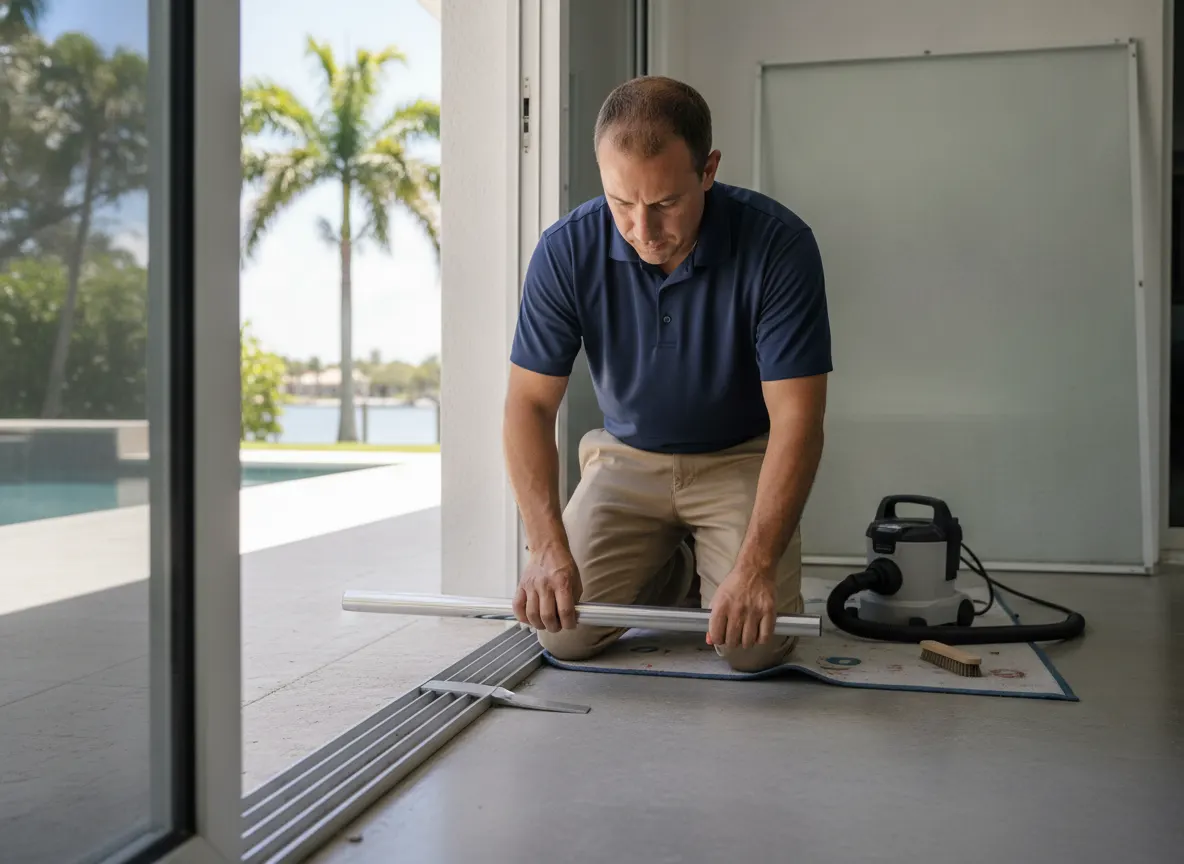
The track is the runway your door lives on, and in coastal Florida it takes constant abuse: sand grinds into the rail, salt pits the aluminum, and failed rollers carve grooves into the surface. Once a track is damaged, no amount of cleaning brings it back — customers tell us all the time, "I vacuumed and lubricated it and it's still awful." That's because the rail itself has become sandpaper.
The good news: a damaged track almost never means a new door. Light wear can be cleaned, dressed and smoothed. Heavier pitting is solved with a stainless-steel cap track — a precision-formed sleeve that fits over the existing rail and gives your rollers a brand-new, corrosion-proof running surface. Paired with fresh stainless rollers, a capped track makes a decades-old door glide like a showroom unit, at a small fraction of replacement cost.
Signs of track damage
- The door catches or bumps at the same spot on every pass
- You cleaned and lubricated the track and it's still hard to slide
- Visible pitting, white oxidation, or a worn groove along the rail
- A flattened or dented section where something was dropped on the track
- New rollers wore out quickly — a damaged track eats them
- The door rides unevenly, tight in one section and loose in another
What track service includes
- Assessment of the full rail — wear, pitting, corrosion, and straightness
- Deep cleaning and dressing of lightly worn tracks
- Stainless-steel cap track installation over pitted or grooved rails
- Repair of bent or damaged track sections
- Roller inspection — track and rollers fail together, so we always check both
- Weep-hole clearing so storm water drains off the track as designed