
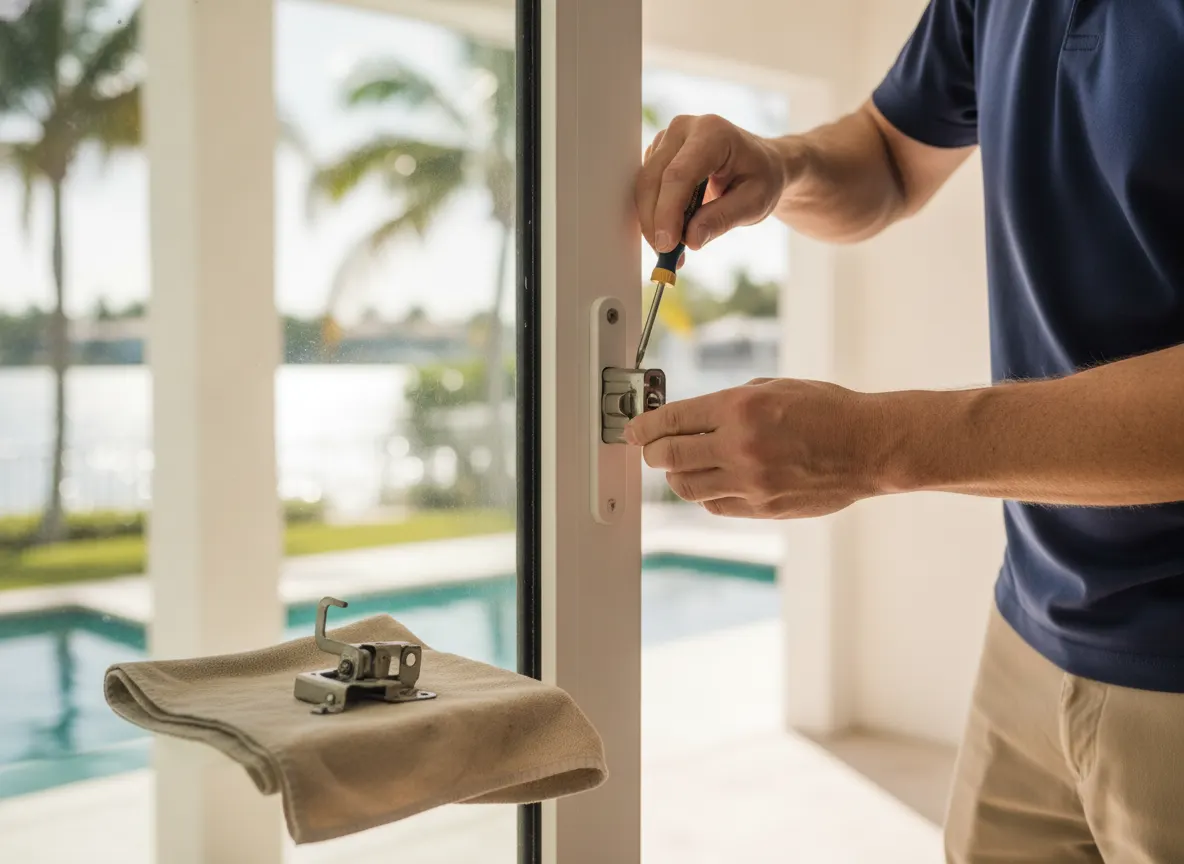
A sliding door that won't lock isn't a maintenance item — it's an open door. The most common failure we see across South Florida is a latch that simply no longer meets its keeper: as rollers wear and the panel drops, the hook-style latch drifts millimeters out of alignment until one day it stops catching entirely. The lock itself is often fine; the door has moved around it.
We repair and replace every common sliding-door locking system — mortise locks, hook latches, keyed cylinders, and foot bolts — and we solve the alignment problems that caused the failure, not just the hardware. For homeowners who want more security than a forty-year-old builder latch provides, we install modern double-bolt and high-security mortise systems that resist prying and lifting, the two ways sliding doors are actually attacked.
Signs of lock and latch trouble
- You have to lift, wiggle or slam the door to get the lock to catch
- The latch clicks shut but pops open with a light tug
- The thumb-turn spins loosely without moving the hook
- A key cylinder that no longer turns, or a lost key situation
- Visible gap between the closed panel and the jamb near the latch
- The door lock stopped catching after the door got harder to slide — the classic alignment chain
What lock service includes
- Diagnosis of the true failure: hardware, keeper alignment, or panel drop
- Mortise lock and hook-latch replacement with parts matched to your door series
- Keeper repositioning and panel height correction so the latch meets cleanly
- High-security and double-bolt lock upgrades for prying/lifting resistance
- Auxiliary security: foot bolts and secondary locks for glass doors
- A firm pull-test with you watching — a lock you can't trust isn't a lock